Showing posts sorted by relevance for query wwdc. Sort by date Show all posts

Will the iPhone get its own Mac Pro moment?


There’s no argument that the Mac Pro was in need of some love and in fact, we’d argue that it’s been overdue some attention for quite some time now. We’d hoped that Apple would offer some signs that the Mac Pro was still in their hearts at this year’s WWDC, but we never invisaged something like what Phil Schiller finally announced on-stage. It was a wow moment the likes of which we don’t recall since the original iPhone introduction.
Which got us thinking.
With iPhones being released each year, and with leaks almost commonplace when it comes to Apple’s suppliers, are we in danger of growing bored with Apple’s iPhone? Perhaps more accurately, are we no longer capable of being surprised by a newly announced smartphone from Apple?
Or, as the title asks, will the iPhone get its own ‘Mac Pro moment’ soon?
When Apple announced the newly redesigned Mac Pro during its opening WWDC keynote, a rare thing happened. Apple was announcing a product refresh, and a major one at that, that none of us saw coming. Yes, a new Mac Pro had been semi-expected at each Apple event for some time, but what we got at WWDC was certainly not what most of us could dare dream of. The new Mac Pro pushes boundaries and changes the way we think about the product. With each iPhone, Apple tweaks and itterates, but is it still capable of taking a device that is undoubtedly hugely popular and completely redesigning it from top to bottom?
It is, of course, debateable whether it needs to. After all, if it ain’t broke, don’t fix it. But a product can grow stale long before it breaks, and while the iPhone 5 is certainly a gorgeous piece of kit, will the next iPhone offer the leap in quality and design that we saw when moving from the iPhone 3GS to the iPhone 4?
Since that time Apple has lost its leader and gone through plenty of changes inside the company. It’s been accused of losing focus and being unable to innovate anymore – both accusations that clearly hurt Apple, as witnessed by the way Phil Schiller announced the new Mac Pro a few weeks ago. If Apple’s new powerhouse desktop machine can be stripped down and rebuilt from the bottom-up, can the iPhone also be rethought?
We’re obviously asking more questions than we are answering here, and with good reason. Apple as it is today is something of an unknown quantity. Just as we come to terms with Steve Jobs’ passing and the crowning of Tim Cook as the new king, we’re now in the midst of changes inside the iOS team with Scott Forstall’s departure. We’ve already seen the first results of that change with iOS 7, but the night is still young and more changes are no doubt afoot. We find ourselves wondering what else Jony Ive has free reign over now that Forstall is no longer around.
These are interesting times for Apple and the iPhone, and with competition constantly improving, we can’t help but wonder whether Apple has the stomach for the fight.

Apple will live stream WWDC to Apple TV, iOS, and its website

Great news for those not standing in line at Moscone West right now: Apple will live stream the entire WWDC keynote via the Apple TV.
This really is awesome news, and it’s a huge treat for those of us who own an Apple TV. In fact if you check your device right now, you should see the official WWDC app on the Home screen.
Yes, Apple has provided a live stream via the Apple TV in the past, and it was fairly decent. If memory serves correctly, the Apple TV stream experienced a few hiccups the last time it used it to stream a keynote, but it wasn’t half bad, and certainly better than following updates via Twitter, or one of the gazillions of live blogs available during the keynote.
But what if you don’t own an Apple TV? Don’t fret. Apple just confirmed you’ll be able to stream the event via an iOS device, or directly from Apple’s website.

New iOS 7 concept depicts Zen-like simplicity


Another day, another iOS 7 concept. In an attempt to depict what Jony Ive-ified, flatteneduser interface in iOS 7 might look like, digital agency Simply Zesty created this elaborate concept.
The video focuses on a clean look UI and pictures Lock screen widgets, a revamped Notification Center as well as a beautiful new Windows Phone ‘Metro’-fied stock apps like Calendar, Music, Siri and Camera.
I love the cleaner Notification Center with animated widgets. If that’s the future of iOS 7, then I’m very much looking forward to it…
Here’s the video.
By the way, what’s up with those square Home screen icons?
Here are the slides, via The Next Web.


 There’s certainly no shortage of iOS 7 concept as WWDC draws near. An iOS 7 concept by Mohamed Kerroudj seems to be getting a little more attention than others so check it out for more awesomeness, including a new Dashboard feature.
Apple said it will put “new versions of iOS and OS X” into the hands of developers at WWDC, its annual summer developers conference which this year takes place at Moscone West in San Francisco from Monday, June 10 until Friday, June 14.


Apple’s created mockups of iMessage for Android, including one with pure Material Design

I was just reading a post titled “On iMessage’s Stickiness” from Apple pundit John Gruber,published last evening on his Daring Fireball blog, and stumbled upon an interesting passage alleging that Apple’s created several mockups of iMessage for Android.
One of the mockups of iMessage for Android reportedly looks like a carbon copy of its iOS counterpart, with another one based on Google’s Material Design guidelines.
“I’ve heard from little birdies that mockups of iMessage for Android have circulated within the company, with varying UI styles ranging from looking like the iOS Messages app to pure Material Design,” reads the post.
MacDailyNews started the iMessage for Android rumor earlier this year.
The report claimed Apple would announce an Android edition of the iMessage service at WWDC 2016. WWDC came and went without any mention of iMessage for Android.
The new report from Gruber suggests that Apple has at least explored the idea before ultimately choosing to abandon or delay iMessage for Android.
Naysayers could say that Steve Jobs promised to turn FaceTime into an open standard that would be supported by carriers and device makers, which never came to be.
“I don’t think we’re ever actually going to see FaceTime as an open standard,” wrote Gruber. “But I think the sentiment that drove Jobs to want it to be an open standard applies to the idea of releasing iMessage for Android. Apple doesn’t need to rely on platform-exclusive lock-in.”
Apple Music for Android has a Material Design feel to it so I’m not surprised that Apple was considering giving iMessage for Android the same look and feel as many other Android apps built around Material Design.
What’s your opinion on iMessage for Android?
Would Apple be better off releasing iMessage for Android or should the service remain exclusive to iOS device as a crucial part of iMessage’s stickiness?
Source: Daring Fireball

Download iOS 7 Beta Direct Links - iPhone 5/4S/4 iPad 4/3/2/mini, iPod Touch 5G, 4G

During WWDC 2013 Apple has announced the completely redesigned iOS 7 with its new awesome features. If you missed the WWDC 2013 event, you can check out iOS 7 official video to check the new features that landed to iOS 7. Apple confirmed that iOS 7 will be released for public by this fall. Now, Apple has just released iOS 7 beta 1 version for developers only, but if you are not a developer, don't worry you can download it directly from the below links


 Download iOS 7 - Un-Official links (without developers account) 

    - Download iOS 7 iPhone 5 (Model A1428)
    - Download iOS 7 iPhone 5 (Model A1429)
    - Download iOS 7 iPhone 4S
    - Download iOS 7 iPhone 4 (GSM Rev A) (Uploading ...)
    - Download iOS 7 iPhone 4 (GSM)
    - Download iOS 7 iPhone 4 (CDMA)
    - Download iOS 7 iPod touch (5th generation)
    - Mobile Device Installer Package (Uploading ...)

    How to install iOS 7 Beta on your iPhone - Click Here

    Apple’s created mockups of iMessage for Android, including one with pure Material Design

    I was just reading a post titled “On iMessage’s Stickiness” from Apple pundit John Gruber,published last evening on his Daring Fireball blog, and stumbled upon an interesting passage alleging that Apple’s created several mockups of iMessage for Android.
    One of the mockups of iMessage for Android reportedly looks like a carbon copy of its iOS counterpart, with another one based on Google’s Material Design guidelines.
    “I’ve heard from little birdies that mockups of iMessage for Android have circulated within the company, with varying UI styles ranging from looking like the iOS Messages app to pure Material Design,” reads the post.
    MacDailyNews started the iMessage for Android rumor earlier this year.
    The report claimed Apple would announce an Android edition of the iMessage service at WWDC 2016. WWDC came and went without any mention of iMessage for Android.
    The new report from Gruber suggests that Apple has at least explored the idea before ultimately choosing to abandon or delay iMessage for Android.
    Naysayers could say that Steve Jobs promised to turn FaceTime into an open standard that would be supported by carriers and device makers, which never came to be.
    “I don’t think we’re ever actually going to see FaceTime as an open standard,” wrote Gruber. “But I think the sentiment that drove Jobs to want it to be an open standard applies to the idea of releasing iMessage for Android. Apple doesn’t need to rely on platform-exclusive lock-in.”
    Apple Music for Android has a Material Design feel to it so I’m not surprised that Apple was considering giving iMessage for Android the same look and feel as many other Android apps built around Material Design.
    What’s your opinion on iMessage for Android?
    Would Apple be better off releasing iMessage for Android or should the service remain exclusive to iOS device as a crucial part of iMessage’s stickiness?
    Source: Daring Fireball

    Bloomberg: Apple’s iAd team gearing up for new iRadio service

    This weekend was chock-full of iRadio news, with multiple reports claiming that Apple reached a deal with the Warner Music Group on Sunday in an effort to wrap up negotiations involving its Pandora-like music service in time for WWDC next week.
    And that trend continues today with a new scoop from Bloomberg regarding the service. The outlet is reporting this afternoon that Apple is revamping how it sells mobile ads to better cater to businesses that apparently can’t wait to advertise on iRadio…
    Bloomberg’s Adam Satariano reports:
    “Apple Inc. (AAPL), planning to release a music-streaming service next week, is revamping how it sells mobile advertising to cater to businesses eager to reach customers as they listen to songs, people familiar with the changes said.
    The company has taken steps to be more flexible with advertisers to get more business. Apple has required marketers to pay a fee for each 1,000 times an advertisement is placed in an app, plus an additional $2 for every time a customer clicks that ad. In some cases, Apple has eliminated one of those charges, one person familiar with the company said.
    Apple also has cut prices so that media agencies can spend $1 million and use the purchased space for different advertising clients. And Apple started taking ad business from companies that sell alcohol, something Jobs resisted after creating iAd, said one person.”
    The report goes on to say that Apple is pitching its network to advertisers by emphasizing the data it has at its disposal for targeting, which for example, includes a history of the movies, music, books and applications each user has paid for and downloaded.
    Perhaps more interesting is the fact that Bloomberg indicates in the story that it has independently confirmed Apple is pushing hard for a WWDC reveal of its streaming music service. That adds weight to an already credible theory first proposed by The New York Times and CNET. Unless something huge comes up, we’re expecting to see it debut next week.
    Few concrete details are known about the so-called ‘iRadio’ service, but the rumor mill seems to have a pretty good idea of what it is. By all accounts, the service will be free for users, supported by ads (similar to Pandora), and offer unique features like the ability to fast-forward and rewind songs.

    Apple said to be working with Logitech and others on MFi gamepads

    Yesterday we talked a little bit about a new feature (or rather, developer API) in iOS 7that offers support for MFi (Made for iPhone) certified hardware game controllers. This will be the first time that Apple has officially supported third party gamepads.
    Today a few more details have surfaced about Apple’s plans regarding these controllers. A new report is out this afternoon claiming that the Cupertino company is working with the likes of Logitech and MOGA to produce a new line of iOS gaming peripherals…
    AppleInsider reports:
    “During the session, which is available as a video to all registered Apple developers via the WWDC app, it was also announced that Logitech and Moga are already collaborating on initial hardware designs for the game controller.
    A closer look at the presentation, however, revealed just how serious Apple is in making standardized game controllers a reality in iOS 7. Titled “Integrating with Game Controllers,” speakers ran through a fairly comprehensive set of app frameworks and other assets that will help developers code games for the proposed controllers. Logitech even had prototypes on hand.”
    Apple apparently offered two hardware examples during the session, similar to the two we outlined in yesterday’s report. One was a form-fitting controller, that wraps around your iPhone or iPod touch, and the other was a standalone model that connects wirelessly.
    The report goes on to say that while Apple touted the benefits of having standardized hardware specifically for iOS gaming, it made it clear that it should not be required. It is, though, looking to help app developers deploy game controller-ready titles in its MFi initiative.
    It’ll be interesting to see how this plays all out. Apple’s iOS is already one of the top gaming platforms, and that’s without it really putting a lot of resources behind it. Imagine what it will be like with this new gamepad support, and possibly Apple TV support, in the future.
    Top image via LaptopMag

    Pod2g confirms evad3rs are not working on 6.1.3 jailbreak


    evasi0n jailbreak mac tutorial 09
    It’s been nearly two weeks now since Apple released iOS 6.1.3 that effectively killed the evasi0n jailbreak. It had a good run though, lasting  for nearly 6 weeks, through 2 iOS software updates, and jailbroke close to 20 million devices.
    And it looks like that’s it for jailbreaks for a while. We had an inkling there wouldn’t be a 6.1.3jailbreak released—it doesn’t make sense to burn exploits before iOS 7— and the evad3rs‘ pod2g just confirmed our suspicion on Twitter…
    Here’s the tweet:


    Again, this doesn’t really come as much of a surprise. Apple is expected to unveil the next version of iOS, presumably iOS 7, at its WWDC event, and that typically happens around mid-June. So that’s what, just over two months away?
    This makes it virtually pointless for the evad3rs to update the evasi0n jailbreak tool with new exploits, as Apple would certainly patch them in iOS 7. And then you’ve burned usable exploits, which seem to be getting harder to find.
    It is worth noting, however, that p0sixninja recently announced that he has discovered enough exploits to produce a new jailbreak. And although it’s very unlikely, it’s possible he could release it before Apple unveils the next version of iOS.
    But my money is on us not seeing a new jailbreak until late-summer, or even the fall. So [obviously] you’ll want to stay away from iOS 6.1.3, and any future iOS 6.x updates, and follow the steps in our ‘How to protect your jailbreak’ guide.

    iOS 7 preview: Multitasking


    iOS 7 finally brings multitasking to everyone on the iPhone, iPod, and iPad. And by everyone, I mean every app, at practically any time. Of course, iOS has always had fantastic multitasking. From the very first demo of the very first iPhone by Steve Jobs in 2007, its ability to fade music out, take a phone call, grab a picture and email it, then return to the phone call, hang up, and fade right back into the music seemed miraculous to the crash-prone competition of the time.
    Then the App Store happened, and all those third-party apps weren't allowed anywhere near the background. Things changed in 2010 with iOS 4, when streaming music, VoIP, and turn-by-turn navigation were granted persistent access to multitasking, and many other apps were given a few minutes of leeway, and the ability to go to sleep and restart, theoretically, right where they left off. But it wasn't enough.
    Thanks to some system-side smarts, however, it looks like iOS 7, along with a new interface, will make good on the multitasking promise while at the same time protect battery life and performance. If they can do it, they'll be the first to really nail multitasking on mobile.
    Here's how Apple describes multitasking in iOS 7:
    Multitasking has always been a smart way to switch between apps. Now it’s even smarter. Because iOS 7 learns when you like to use your apps and can update your content before you launch them. So if you tend to check your favorite social app at 9:00 a.m. every day, your feed will be ready and waiting for you. That’s multitasking in iOS 7. It knows what you want to do before you do.
    Keep the content of your app up-to-date by adopting the new multitasking APIs in iOS 7. The new services allow your app to update information and download content in the background without draining the battery unnecessarily. The updates can happen at opportunistic times and are intelligently scheduled according to usage, so your app can update content in the background just when your users need it.

    Based on what Apple's shown off at WWDC 2013 and on the web to date, here's how the new interface, and the new functionality works:
    • Accessing multitasking still requires a double click of the Home button, which is consistent for existing users but probably not as intuitive as the upward swipe seen on some other platforms. (And which Control Center has just taken on iOS.)
    • The old Fast App Switcher tray has been replaced with a new card-based interface. It looks a lot like webOS cards, though iOS Safari Pages used that mechanic first. It lacks the Stacks functionality of later versions of webOS, but it does retain the icons of the Fast App Switcher which greatly increases glance-ability.
    • Thanks to the new card-based interface, apps can be closed by touching them and tossing them away, again like webOS. Apple hasn't said if multiple cards can be tossed away at once, though iOS is multitouch and up to three cards can appear on the screen at one time...

    • Intelligent scheduling means that, if you use an app frequently - for example, if you check Facebook or Twitter constantly - iOS 7 will recognize that and allow the app to update frequently so whenever you launch it, it'll have all the latest information already waiting for you. If you use an app regularly but not frequently - for example, if you check the news when you wake up and before you go to sleep - iOS 7 will recognize that as well and allow the app to update just before you usually check it.
    • Opportunistic updates takes advantage of the many times a day you unlock your device and power up the system - for any reason - to allow apps to access background cycles.
    • Adapting to network conditions means that, whenever a radio signal is strong and power use is at a minimum, iOS 7 will allow updates that need that radio.
    • Coalesced updates recognizes that when one app powers up a radio, other apps can tag along and get their background requests done as well.
    • Push triggers fixes the years-old problem of getting a notification only to go to the app and not find the data there. Now, in iOS 7, the notification itself will trigger the update, hopefully retrieving data just before you arrive at the app.

    Mobile multitasking is all about compromise. You either limit what can be done by apps, or you limit the battery life of the device running them. With iOS 7, Apple is trying to have their background and their battery life too, and they're using a lot of super-smart technology to achieve it. Instead of simply allowing persistent, pre-emptive multitasking like OS X does on the desktop, and like how some competitors do on mobile, Apple is recognizing that they have neither a power cable plugged into the wall, or a desire to offload battery and task management to their users, and they're deploying a just-in-time system to get the best of both worlds.
    Perception is reality. Until we open an app, we have no way of knowing whether it was updated or not. So, iOS 7 will keep track of when we open apps and try and update them just-in-time so that, when we get there, our data is ready and waiting for us, and not us for it. Intelligent scheduling should make sure that most of the time, most of our apps are updated, however it remains to be seen what will happen when infrequently used apps are opened?
    Perhaps the other systems will kick in then. Opportunistic updates, whether they're because we've turned on our iPhone, iPod, or iPad, or the radios have locked onto a good, strong signal, or another app is firing up a radio and letting hitchhikers come along for the ride, there should be plenty of chances for plenty of apps to update when they'll have the least impact on the system but the most on making sure our data is present for when we want and need it.
    Likewise, updating on push notification is huge. Many times I've had to go back to Notification Center to try and glean as much as I can from the tiny preview text in an alert because the actual message is taking so long to actually come in. Now, the notification itself will tell the app to update, and hopefully it'll be quick about it.
    Whether this applies to content as well as data is unclear. Apple hasn't said anything publicly yet about whether episodic or periodical content can "wake up" the system and cause a download in advance of our going to look for it. Newsstand works that way now, and rumors of Apple's iTunes and Podcasts apps getting the same ability have persisted since iOS 6. Come release, will we see that kind of update functionality everywhere? What exactly developers will be able to do, and what they'll be able to figure out around it, remains to be seen.
    In webOS, every instance of an app could have a card. For example, you could have multiple web pages open at the same time in card view, or multiple email message drafts ready and waiting. There's an argument to be made that one app, one card is simpler, but it's also less powerful. webOS used Stacks to even better organize workflows. Again, greater complexity, but greater functionality.
    Tossing cards away is also a much better model than iOS 4 - iOS 6 implemented. Holding icons down until they jiggle, and tapping tiny X icons, conflating app deletion on the Home screen, wasn't great for anybody.
    The addition of the icons to the card view in iOS 7 is a huge win, however. Cards capture static views from the apps they represent, but those views might not be recognizable. Icons are made to be recognizable, even at a glance. Cards and icons together provide both information and discoverability. Back before iOS 6, I and many others hoped for a better fast app switcher and for the most part, Apple exceeded those hopes.
    And it can only get better from here.
    The updated multitasking interface and functionality will ship as part of iOS 7 this fall. Check out the resources below for more, and let me know - is iOS 7 multitasking everything you wanted it be? Did Apple strike the right balance, or is something still missing?

    The horrible state of Android fragmentation

    OK, so let’s make this blatantly clear: Apple’s iOS platform is by no means prone to device/OS fragmentation problems, but nowhere near like Android. In addition to just four screen resolutions, iOS developers, at best, must optimize their warez for a few percent customers who haven’t yet upgraded to the latest and greatest version of Apple’s mobile operating system.
    Contrast this to Android, where Google’s proclaimed openness and the multitude of device vendors, carriers and suppliers all contribute to the vast array of Android smartphones and tablets that come in hundreds of form factors, screen sizes and price points.
    An extensive survey of some 682,000 Android devices has revealed the frightening scale of Android fragmentation and its impact on both users and developers…
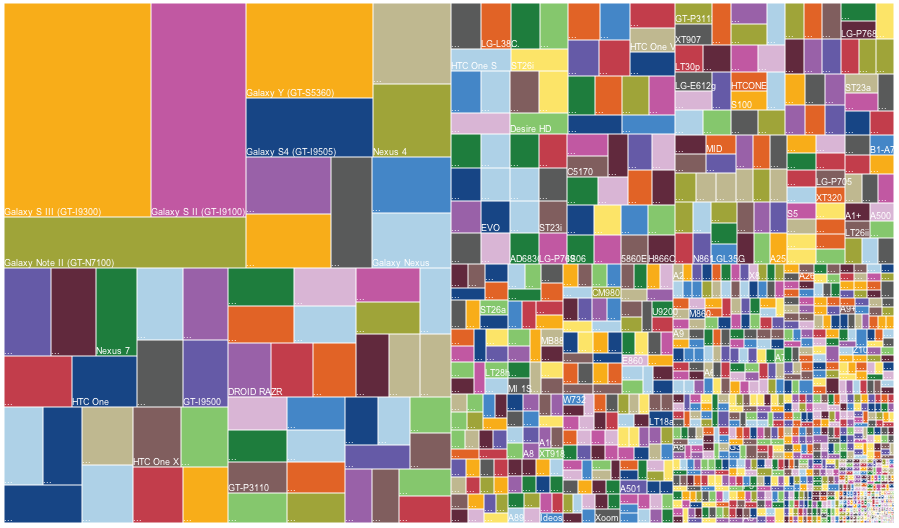
    UK-based OpenSignal, which specializes in crowdsourced wireless coverage mapping, counted a whopping 11,868 distinct Android devices which downloaded their app this year, nearly three times more compared to the 3,997 distinct Android devices running the OpenSignal app in 2012.
    As you can see on the image top of post, last year Samsung’s Galaxy S2 was the most used Android device.
    This year, it’s the Galaxy S3 (below).
    As for brand fragmentation, Samsung leads the pack by a huge margin: an astounding 47.5 percent share of the Android market is owned by Samsung devices, distributed across more than a hundred different models. By comparison, the #2 Sony-Ericsson enjoys less than one-sixth of Samsung’s presence, at 6.5 percent market share.
    All flavors and variants of devices made by Google-owned Motorola ended up with a 4.2 percent share (3.9 percent for HTC). The data point clearly highlights why Google is concerned about Samsung’s total dominance of the Android landscape.
    “The Android operating system is the most fragmented it has ever been,” OpenSignal remarked.
    As for screen sizes, iOS developers have to think about four different resolutions as opposed to the proliferation of different screen sizes on Android. Check out the various physical screen sizes OpenSignal observed on Android phones, with the darkness of the lines representing their frequency.
    And now, compare this to iOS.
    If you’re an iOS developer, coding for the platform makes a world of difference. Because Apple tends to double pixel density while quadrupling resolution while maintaining the same physical screen size, there are just four different physical screen sizes to code for on the iOS platform.
    On the upside, fragmentation does serve as an enabler of the Google ecosystem by allowing for a broader, more geographically dispersed Android market. Fragmentation also benefits consumers through endless choices in terms of screen sizes, price points and feature combinations.
    As for developers, the sheer number of Android devices out there represents an opportunity, even if tapping that user base entails spending significant resources to optimize their apps for multiple form factors and Android OS versions.
    Take it from David Berlin, lead for the BBC iPlayer Android team, who recently said:
    Today we have an Android development team that is almost 3 times the size of the iOS team.
    That speaks volume about the difficulties developers faces coding for Android.
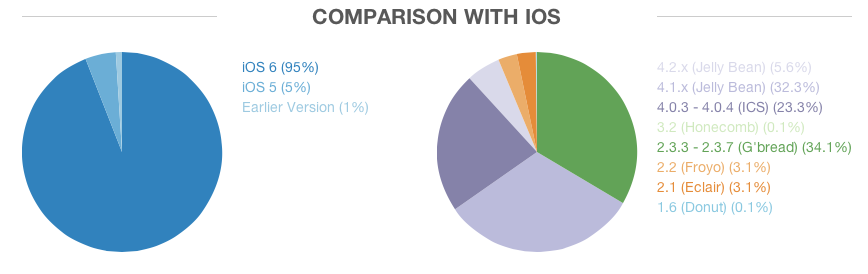
    Yes, Android has now surpassed one billion activations, as opposed to 600,000 cumulative iOS device activations, but that’s beyond the point for our discussion. Here’s Android fragmentation in comparison with iOS, as viewed from the API fragmentation standpoint.
    Apple’s CEO Tim Cook took a jab at Android during his WWDC 2013 keynote talk, highlighting the fact that 93 percent of his company’s customers run the latest iOS 6 version, as opposed to Android’s 33 percent of Jelly Bean users, 37 percent of Gingerbread (the most prevalent Android version) and 26 percent of Ice Cream Sandwich.
    “If you do the math, you would find that iOS 6 is the world’s most popular mobile operating system, and in second place is a version of Android which was released in 2010,” Cook remarked.
    It should be noted that Android stats include only those OS versions that talk to Google’s Play store so forked builds like Kindles and Nooks are excluded, as are cheap devices from no-name Chinese vendors.
    “This version fragmentation is terrible for developers, as many of you know,” Cook pointed out. Not just developers: often times Android handset vendors don’t even bother updating existing devices, leaving users stuck on older, less secure and less-featured Android builds.
    And where Apple simply pushes a software update to users whenever it pleases, Android makers are required to test Google’s Android builds against a plethora of different devices and carriers.
    That manufacturers and carriers preload their crapware on top of stock Android experience makes firmware changes a time-consuming, costly affair so most vendors just don’t bother. But lack of updates can have devastating ramifications in terms of platform security.
    Case in point: the Android Master Key vulnerability discovered by Bluebox Labs and affecting a staggering 99 percent of Android users.
    The scary part: even though Cydia developer Saurik posted a fix and Google patched the vulnerability on its own Nexus devices, the majority of handset makers and carriers to this date have not supplied an appropriate firmware update.
    That’s leaving your users out in the cold right there. In all their short-sightedness, Android backers couldn’t (or wouldn’t) see the long-term value in providing timely software updates.
    Over in the Apple land, iOS fragmentation is bound to increase as Apple releases new form-factor devices, such as a rumored smartwatch or a purported full-on television set.
    But unlike Android where developers mostly count on Android to automatically scale up their user interfaces for a target device – resulting in blown-up apps that look weird on tablets – Apple has seen tremendous success persuading its army of developers to code for iPhone and iPad natively, resulting in 350,000 submissions made specifically for the iPad out of the 900,000 apps found on the App Store.
    In other words, although iOS suffers from fragmentation issues, these pale in comparison to the horrible state of Android fragmentation. Worse, fragmentation now poses a significant headache to Google developers who are required to test and optimize their apps on an ever-increasing number of devices.
    OpenSignal has posted additional infographic and above charts in interactive form on its website so do check out the report and come back here to comment below.

    iOS 7 Untethered Jailbreak Or iOS 6.1.3 Untethered Jailbreak !!


    iOS 7 Untethered Jailbreak Or iOS 6.1.3 Untethered Jailbreak !! - Evasi0nwas one of the most popular Jailbreak released for iOS 6 and 6.0.1. But due to many glitches and security problems, Apple released iOS 6.1.2. However, iOS 6.1.2 wasn’t without bugs, so, the Fruit Company released iOS 6.1.3 which didn’t only fix the Lockscreen bug but also fixed many exploits found by Evaders.
    We have already warned you guys about not to updating the iOS 6.1.3 because Evasi0n Jailbreak doesn’t work with it. If you have willingly or unwillingly updated to iOS 6.1.3, we have a bad news for you because Evad3rs are not working for iOS 6.1.3 Jailbreak.

    iOS 7 Untethered Jailbreak Or iOS 6.1.3 Untethered Jailbreak !!

    iOS 7 Untethered Jailbreak Or iOS 6.1.3 Untethered Jailbreak
    We are already expecting this from Evad3rs and the main member of team, Pod2g confirmed this news via twitter. Here’s what he tweeted in reply to a question about iOS 6.1.3 Jailbreak.
    We are not working on a 6.1.3 jailbreak that would be too much efforts for a minimal update. We’re waiting for a major release.
    Finding exploits and making an appropriate Jailbreak is not an easy feat. The developers have to work very hard to get the stable untethered Jailbreak. We believe that this is a very good decision from Evad3rs. There are many reasons behind this choice, the first one is that Apple will soon release the Major iOS 7 with new changes and will surely fix all the bugs in this new version. So, if the developers release iOS 6.1.3, it will give a clue to Apple which will fix the exploits in the iOS 7.
    Apple will probably announce iOS 7 in the mid June of 2013 at WWDC and we will not see any Jailbreak until this summer. What do you think about this decision? Let us know in the comments section below

    FiftyThree’s Paper updated with new iOS 7 design, improved zoom and more


    FiftyThree announced a significant update for its popular Paper for iPad drawing app this afternoon, bringing the app to version 1.6.1. The update brings about an iOS 7-inspired redesign with new fonts, buttons and toggles, as well as a handful of other improvements.
    Among those improvements are more powerful zoom and ink—when you zoom in on your artwork, your tools do too, giving you finer control over the smaller areas—and better dot control. Now, the dot size in your Draw and Erase tools is linked to how long you press…
    Here are the release notes on 1.6.1 from FiftyThree’s blog:
    Brighter, Fresher, Clearer, Simpler. 
    Paper is now built for iOS 7. It’s the same Paper creators around the world know and love with a fresh new look to improve readability to keep you in your creative flow. You’ll find faster menus, simplified icons, lighter colors, journal covers that pop, custom typefaces, and overall improved readability. It combines the emotional power of metaphor and the functional clarity of clean design. In other words, we’ve polished every pixel.
    More Powerful Zoom & Ink.
    Zoom isn’t just about getting closer, it’s about having the tools to do detailed work. Now when you zoom in, your tools do too. Draw, Color, Erase, and Blend adjust their size in the loupe to give you finer control over tiny areas without ever touching a slider.
    Dot Dot Dot. 
    Master the dot. Dot size in the Draw and Erase tools is now linked to how long you press. Tap quickly to make small dots, or hold down longer to create bigger ones. Starry skies and spotted cows are now easier to draw than ever.
    For those who aren’t familiar with the app, Paper gives you a canvas to capture your ideas as sketches, diagrams, illustrations, notes or drawings and share them across the web. And it’s won countless of awards for its design, including an Apple Design Award at WWDC in 2012.
    If you’re a current user not seeing version 1.6.1, give it a minute, it seems like the update is still rolling out. And for those of you who don’t have the app already, you can find Paper for the iPad in the App Store for free. Warning: some tools are locked and tied to in-app purchases.